
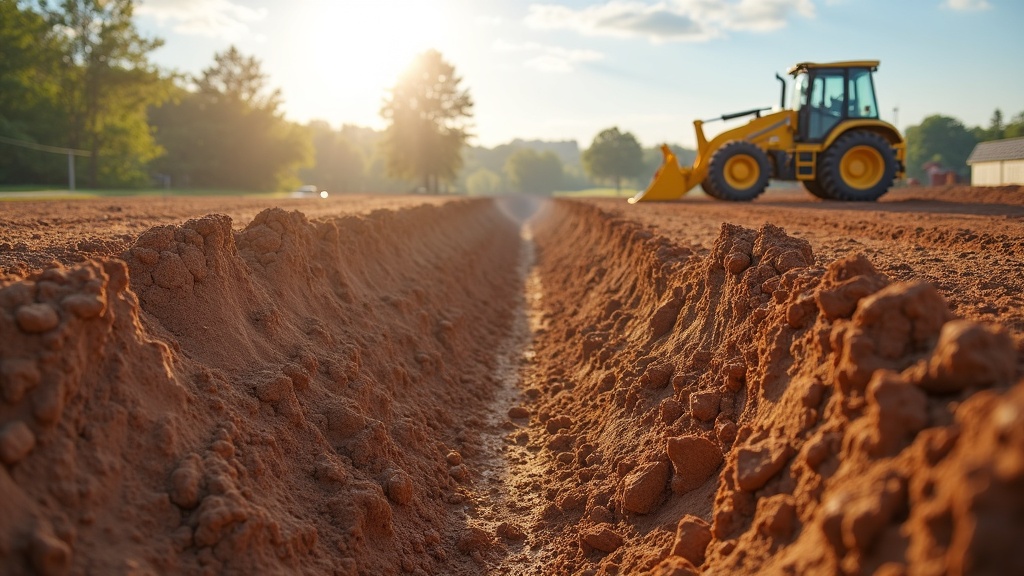
Trenching and backfilling: Best practices for mining operations
Learn how proper trenching and backfilling techniques prevent ground settlement and structural failure in mining and heavy civil projects. This article covers compaction lift limits, material selection, equipment choices, and quality control methods used by industry professionals.
Table of Contents
- Compaction Lift Thickness and Equipment Selection
- Material Selection for Stable Backfill
- Quality Control and Testing Methods
- Modern Equipment and Safety Innovations
- Frequently Asked Questions
- Comparison: Mechanical vs. Hydrovac Excavation for Trenching
- Practical Tips for Trenching and Backfilling
Trenching and backfilling is the process of excavating a narrow trench and then replacing and compacting soil or engineered fill to restore ground support. Proper lift thickness, material selection, and compaction methods are critical to preventing pavement distress and settlement in mining and infrastructure projects.
Quick Stats: Trenching and Backfilling
- The global trench backfiller equipment market was valued at $1.2 billion in 2024 and is projected to reach $1.8 billion by 2033 (Verified Market Reports, 2024)[1].
- The US excavation contractors industry, which includes trenching and backfilling activities, is estimated at $142.5 billion in 2026 with 236,000 businesses operating (IBISWorld, 2026)[2].
- Improper trench backfilling and compaction are significant contributors to premature pavement distress and utility trench settlement (Minnesota Department of Transportation, 2023)[3].
Introduction
Trenching and backfilling forms the backbone of underground utility installation, foundation work, and mining infrastructure. When done correctly, the process restores the ground to its original load-bearing capacity. When done poorly, it leads to sinking pavement, damaged pipelines, and costly rework. The global market for trench backfiller equipment reached $1.2 billion in 2024 (Verified Market Reports, 2024)[1], reflecting the scale of this essential construction activity. In mining operations, where heavy equipment and dynamic ground conditions are the norm, getting trenching and backfilling right is especially critical. This article covers the four pillars of successful backfill operations: compaction lift limits, material selection, quality control, and modern equipment innovations.
Compaction Lift Thickness and Equipment Selection
The single most important factor in backfill quality is controlling lift thickness during compaction. The Minnesota Department of Transportation advises that heavy construction equipment should be used to compact only the upper lift in a trench, and this lift should be restricted to the range of 1.0 to 2.5 feet in thickness depending upon the soil type and the traffic load (Minnesota Department of Transportation, 2023)[3]. This guidance applies directly to mining access roads, tailings pipeline trenches, and haul road construction where heavy haul trucks impose significant loads.
Why Lift Thickness Matters
Each lift of backfill material must be thin enough that compaction energy penetrates the full depth. If lifts exceed 2.5 feet, the lower portion remains loose, leading to differential settlement. In trench backfilling, compaction equipment will usually produce a stable backfill in lifts up to 2.5 feet in trenches in low traffic volume streets with sand subgrades (Minnesota Department of Transportation, 2023)[3]. For mining applications with higher load demands, lifts of 1.0 to 1.5 feet are more common.
Equipment Choices for Compaction
Selecting the right compaction equipment depends on trench width, material type, and access constraints. Vibratory plate compactors work well in narrow trenches, while smooth drum rollers suit wider excavations. In mining environments, remote-controlled compactors improve safety when working near unstable trench walls. The objective remains the same: achieve uniform density and support across the trench width so that the backfill performs equivalently to the undisturbed adjacent soil under traffic loading (Minnesota Department of Transportation, 2023)[3].
Material Selection for Stable Backfill
Backfill material and compaction methods for trench excavations must be selected to restore, as nearly as possible, the original strength and support of the in-situ soil (Minnesota Department of Transportation, 2023)[3]. This principle drives material specifications across all trenching projects, from urban utilities to mining infrastructure.
Granular vs. Cohesive Soils
Granular soils such as sand, gravel, and crushed stone drain freely and compact predictably, making them the preferred backfill material. Cohesive soils containing clay require careful moisture control and may not achieve adequate density in confined trench conditions. For mining backfill applications, engineered mixtures of crushed waste rock and cementitious binders are often used to create controlled low-strength material (CLSM) that flows into place without compaction.
Geotechnical Testing Requirements
Before selecting backfill material, conduct a sieve analysis and Proctor compaction test to determine the optimum moisture content and maximum dry density. The material’s plasticity index and fines content will dictate whether it is suitable for structural backfill. In mining operations, the backfill must also resist chemical attack from process water and groundwater. For specialized backfill grouting needs, resources like machine learning and AI training for backfill optimization are emerging as valuable tools for predicting material behavior.
Quality Control and Testing Methods
Quality control during trenching and backfilling prevents the costly failures that plague poorly compacted excavations. The Minnesota Department of Transportation notes that improper trench backfilling and compaction are significant contributors to premature pavement distress and utility trench settlement (Minnesota Department of Transportation, 2023)[3]. A robust testing program catches problems before they become permanent.
Field Density Testing
The nuclear density gauge is the industry standard for verifying compaction in the field. Tests should be performed on every lift, with a minimum of one test per 500 square feet of trench area. The target density is typically 95% of the maximum dry density determined by the Proctor test. For mining haul roads and heavy-load areas, 98% is often specified.
Proof Rolling and Visual Inspection
Proof rolling with a loaded dump truck or rubber-tired roller reveals soft spots that density tests might miss. The operator watches for excessive rutting or deflection, which indicates inadequate compaction. Visual inspection should also verify that lift thickness does not exceed specifications and that material segregation has not occurred. Documenting every lift with photographs and test results creates an as-built record that protects the contractor and owner.
Regular calibration of compaction equipment ensures consistent energy delivery. The US excavation contractors industry has grown at a compound annual rate of 2.8% over the past five years to 2026 (IBISWorld, 2026)[2], reflecting steady demand for these services and the need for professional quality standards.
Modern Equipment and Safety Innovations
The trenching and backfilling industry is adopting new technologies that improve safety, efficiency, and quality. Hydrovac trucks, which use pressurized water and a vacuum system to excavate soil, are gaining traction. Industry research indicates that 78% of hydrovac truck market demand is driven by underground utility protection requirements (Industry Research Biz, 2024)[4], and 64% of adoption growth is linked to safety compliance in excavation and trenching operations (Industry Research Biz, 2024)[4].
Hydrovac Advantages for Trenching
Hydrovac excavation reduces the risk of striking buried utilities because the water stream does not damage pipes or cables. The estimated operational efficiency improvement associated with hydrovac trucks in infrastructure projects, including trenching and backfilling, is 59% (Industry Research Biz, 2024)[4]. This makes hydrovac an attractive option for mining sites where existing underground infrastructure is dense and poorly documented.
Automated Backfill Systems
Manufacturers now offer self-leveling backfill spreaders that place material at precise depths, eliminating the guesswork of manual spreading. Some systems integrate GPS guidance to track lift thickness across the entire trench. These innovations help contractors meet the strict lift thickness requirements recommended by transportation agencies. For mining operations, advanced training programs for backfill equipment operators are becoming essential for maximizing the return on these capital investments.
The trench backfiller market is forecast to grow at a compound annual growth rate of 5.0% between 2026 and 2033 (Verified Market Reports, 2024)[1], driven by infrastructure spending and the need for safer, more efficient excavation methods.
Frequently Asked Questions
What is the maximum lift thickness for trench backfill compaction?
The maximum lift thickness depends on soil type, compaction equipment, and traffic load. For heavy construction equipment, the upper lift should be restricted to 1.0 to 2.5 feet. In low-traffic areas with sand subgrades, lifts up to 2.5 feet are acceptable. For high-traffic areas and mining haul roads, lifts of 1.0 to 1.5 feet are recommended to ensure full compaction energy penetration.
How do I choose between mechanical and hydrovac excavation for trenching?
Mechanical excavation with backhoes or trenchers is faster and more economical in open areas without buried utilities. Hydrovac excavation is preferred when working near existing underground infrastructure, as it eliminates the risk of utility strikes. Hydrovac also offers a 59% improvement in operational efficiency for infrastructure projects and is driven by safety compliance requirements in 64% of adoption cases.
What compaction test is most reliable for trench backfill?
The nuclear density gauge is the most widely accepted field test for compaction verification. It measures in-place wet density and moisture content, allowing calculation of dry density and percent compaction. Tests should be performed on every lift, targeting 95% of the standard Proctor maximum dry density for general applications and 98% for heavy-load areas like mining haul roads.
How does backfill quality affect pavement performance?
Improper trench backfilling and compaction are significant contributors to premature pavement distress and utility trench settlement. When backfill settles, the pavement above cracks and dips, creating a safety hazard and requiring costly repairs. Proper compaction restores the original strength and support of the in-situ soil, preventing differential settlement and extending pavement life.
Comparison: Mechanical vs. Hydrovac Excavation for Trenching
Choosing the right excavation method for trenching and backfilling depends on site conditions, utility density, and project timeline. Both mechanical and hydrovac approaches have distinct advantages. The table below summarizes key differences.
| Factor | Mechanical Excavation | Hydrovac Excavation |
|---|---|---|
| Speed | Fast in open areas | Slower but precise |
| Utility Safety | Risk of strikes | Non-destructive to utilities |
| Operational Efficiency | Baseline | 59% improvement reported |
| Safety Compliance Driver | Standard PPE | 64% of adoption driven by safety |
| Best Application | New construction, remote sites | Urban areas, near existing infrastructure |
Practical Tips for Trenching and Backfilling
Implementing best practices on every trenching project reduces risk and improves long-term performance. Follow these actionable tips.
- Verify lift thickness with a marked rod. Before compacting each lift, check the loose thickness with a survey rod or marked pole. Never rely on equipment operator estimates alone. This simple step prevents the most common compaction failure.
- Moisture condition granular fills. Even free-draining sand and gravel require moisture for effective compaction. Add water to achieve the optimum moisture content determined by the Proctor test. Too dry and particles won’t rearrange; too wet and pore pressure prevents densification.
- Proof roll every trench before paving or backfilling final lifts. A loaded dump truck or rubber-tired roller will reveal soft spots that density testing might miss. Address these areas with additional compaction or removal and replacement before proceeding.
- Document every lift with photos and density test results. Build a complete as-built record that shows lift thickness, material type, compaction method, and test results. This documentation protects against future claims and provides a reference for similar projects.
- Consider engineered backfill for critical mining applications. For trenches under haul roads, tailings lines, or foundation slabs, specify a controlled low-strength material (CLSM) or cement-treated backfill that requires minimal compaction and provides predictable support.
Final Thoughts on Trenching and Backfilling
Successful trenching and backfilling depends on disciplined lift thickness control, appropriate material selection, rigorous quality testing, and modern equipment choices. The global market for trench backfiller equipment is projected to reach $1.8 billion by 2033, reflecting the growing recognition that proper backfill prevents costly failures. By following the compaction guidelines established by transportation agencies and adopting innovations like hydrovac excavation, mining and construction professionals can achieve backfill that performs as well as the undisturbed soil. To continue learning about ground improvement techniques, overcoming business limiting beliefs can help you approach operational challenges with a fresh perspective, while limiting beliefs that block business growth offers insights into removing barriers to project efficiency.
Useful Resources
- Verified Market Reports. Trench Backfiller Market Report 2024.
https://www.verifiedmarketreports.com/product/trench-backfiller-market/ - IBISWorld. Excavation Contractors Industry in the US – Market Research Report 2026.
https://www.ibisworld.com/united-states/industry/excavation-contractors/206/ - Minnesota Department of Transportation. Backfilling Trench Excavations – Progress Report 1962 (reissued as technical guidance).
https://mdl.mndot.gov/_flysystem/fedora/2023-10/investigation-610-progressreport-1962.pdf - Industry Research Biz. Hydrovac Trucks (Hydro Excavation) Market Report 2024.
https://www.industryresearch.biz/market-reports/hydrovac-trucks-hydro-excavation-market-117692